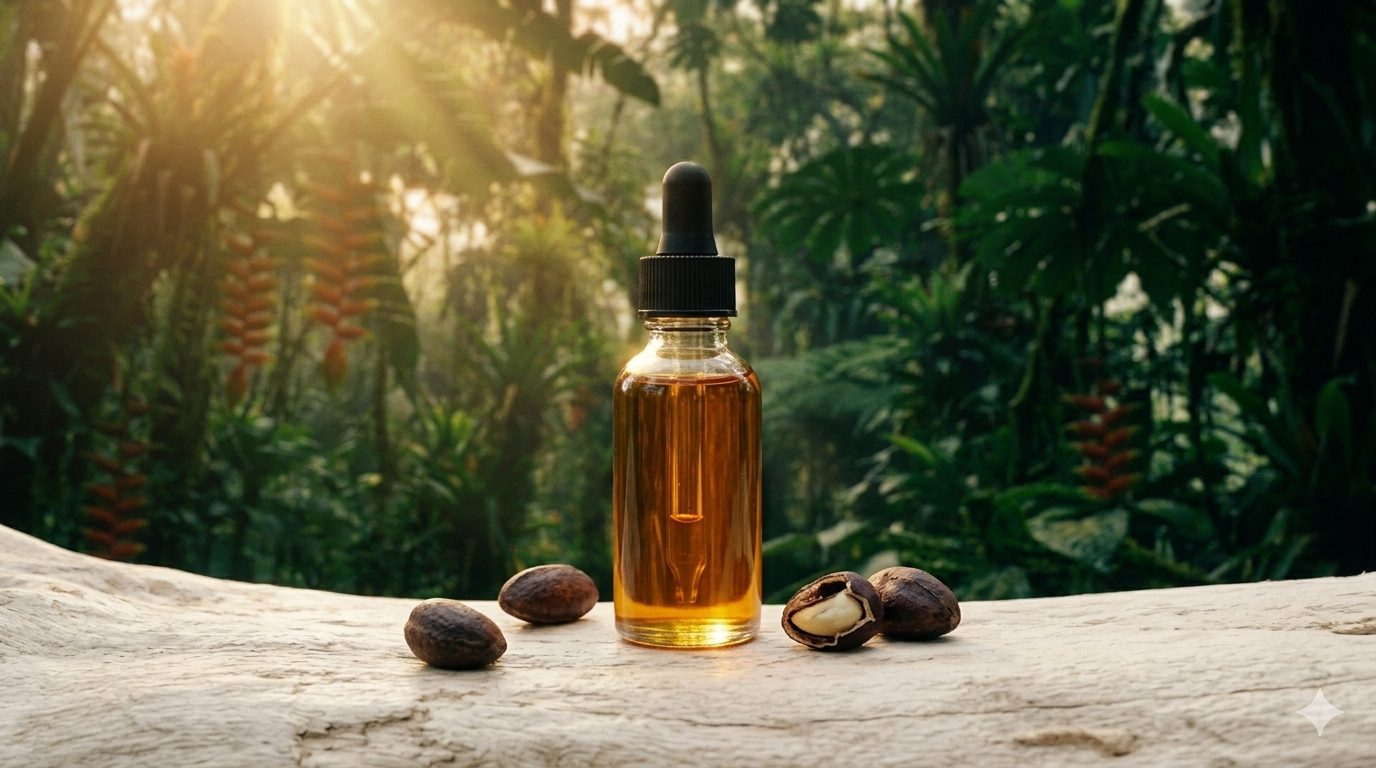
Deep in the Colombian Amazon, a tree grows to forty metres and produces up to 250 kilograms of nuts each year. It has been doing this for centuries. The Piaroa and Yukpa indigenous communities of the Orinoco basin have long used its oil for skin — for burns, wounds, and daily care — passed down without a label, a patent, or a peer-reviewed study to justify the practice.
Modern biochemistry is catching up. What analysis reveals is that Caryodendron orinocense contains one of the highest concentrations of natural retinol (vitamin A), vitamin E (tocopherols), and linoleic acid ever measured in a plant oil. By those measures, it outperforms argan oil, rosehip oil, and most of the oils that have dominated Western cosmetics for the past two decades.
It remains largely unknown outside South America. In 2020, the Slow Food Foundation added the cacay nut to its Ark of Taste — a catalogue of endangered heritage foods at risk of disappearing. That is not a coincidence. It is a warning about what gets lost when markets move slowly.
"The forest does not announce itself. The oil has been there all along — we are simply the ones who decided to read the analysis."
The Numbers
Cacay oil's nutrient profile is not a marketing claim. It is a biochemical measurement. Cold-pressed and unrefined, the numbers hold.
Cacay vs Argan vs Rosehip
The comparison is instructive not because cacay is merely "better," but because the difference in nutritional profile explains why the same outcome — cellular renewal, barrier repair — is achieved more efficiently.
| Cacay Oil Our Pick | Argan Oil | Rosehip Oil | |
|---|---|---|---|
| Vitamin E | Very High — ~100mg/100g+ | Moderate — ~32mg/100g | Low — ~3–5mg/100g |
| Natural Retinol (Vit A) | High — significant natural content | Trace — very low | Moderate — as beta-carotene |
| Linoleic Acid (ω-6) | ~70% | ~35% | ~45–55% |
| Absorption | Fast — dry, non-greasy | Moderate | Fast |
| Comedogenic Rating | 0–1 (non-comedogenic) | 0 (non-comedogenic) | 1 (low) |
| Origin | Colombian Amazon | Morocco / North Africa | Chile / South America |
| Market Awareness | Emerging — rare in Europe | Saturated | Established |
Rosehip oil delivers retinol precursors (beta-carotene, which the skin converts to vitamin A at variable efficiency). Cacay oil delivers the vitamin A directly, alongside a vitamin E concentration that makes argan oil look modest by comparison. Both linoleic acid content and tocopherol levels are measurably higher in cacay than in either competitor — not by a small margin, but by a factor of two or three.
What It Does to Skin
Cellular Renewal — Vitamin A (Retinol)
Retinol is the most clinically supported active ingredient in anti-aging skincare. It works by binding to retinoic acid receptors in the skin, accelerating cellular turnover and stimulating collagen synthesis. The challenge with synthetic retinol is its instability and the irritation it causes in higher concentrations — redness, peeling, photosensitivity.
The retinol in cacay oil exists in its natural matrix — surrounded by tocopherols (vitamin E) and balanced by linoleic acid. This natural stabilisation is significant: the co-factors present in the whole oil moderate the retinol's effect and reduce the likelihood of irritation, making it better tolerated by sensitive skin than isolated synthetic retinol at equivalent concentrations.
Barrier Repair — Linoleic Acid
The skin's outer barrier is composed primarily of ceramides, cholesterol, and fatty acids — including linoleic acid. When this barrier is compromised (by environmental stress, age, or disruption), the skin becomes permeable to irritants and prone to moisture loss. Linoleic acid is the specific fatty acid the body cannot synthesise and must obtain topically or through diet. At ~70%, cacay oil delivers this essential component in concentration that few other plant oils match.
The practical result: faster barrier recovery, reduced transepidermal water loss (TEWL), and improved skin resilience over consistent use.
Antioxidant Protection — Vitamin E
Tocopherols (vitamin E) are the skin's primary lipid-phase antioxidants — the compounds that neutralise free radicals before they can damage the cellular membrane. Most plant oils contain some tocopherols; cacay oil contains an exceptionally high concentration, approximately three times that of argan oil by weight. This makes it unusually effective as a protective layer against environmental oxidative stress — UV, pollution, and the byproducts of metabolic activity.
Collagen Stimulation — Beta-Sitosterol
Less discussed than retinol or linoleic acid, but equally important: cacay oil contains beta-sitosterol, a phytosterol with documented collagen-stimulating and anti-inflammatory properties. Beta-sitosterol competes with cholesterol at the cellular level, reducing inflammatory signalling in the dermis and supporting collagen synthesis independently of the retinol pathway. This triple mechanism — retinol for cellular renewal, linoleic acid for barrier repair, beta-sitosterol for inflammation and collagen — is what makes cacay oil unusually complete as a single-ingredient treatment.
"The skin does not read marketing copy. It responds to chemistry — and cacay's chemistry, at its most honest, is extraordinary."
The Clinical
Evidence
A four-week clinical study conducted by Curelle — participants applying 100% pure cacay oil twice daily — produced the following results across a measured subject group:
Source: Curelle independent clinical study. 4-week duration, twice-daily application of 100% cold-pressed cacay oil. Results based on self-assessment and instrumental measurement of the subject group.
From Colombia
to the Formula
Caryodendron orinocense is native to the tropical lowland forests of Colombia, Venezuela, Ecuador, Peru, and Brazil — specifically the Amazon and Orinoco river basins, at altitudes below 800 metres, with annual rainfall above 2,000mm and humidity above 70%. These conditions cannot be replicated elsewhere. The tree grows to 30–40 metres in the wild, and begins producing fruit between the ages of four and seven years. A single mature ten-year-old tree produces 100–250 kilograms of nuts per year.
In Colombia the species is distributed across five departments — Antioquia, Caquetá, Cundinamarca, Meta, and Putumayo — spanning the Andean foothills, the Orinoquía, and the Amazon basin. The Piaroa and Yukpa communities of the Orinoco region have used the nut medicinally for generations: the oil applied directly to burns, wounds, and irritated skin. This is not anecdote. It is the longest clinical trial in the oil's history.
In 2020, the Slow Food Foundation added the cacay nut to its Ark of Taste — an international catalogue of endangered heritage foods at risk of disappearing due to industrial agriculture and market neglect. Walden Organics sources its cacay oil from certified organic crops in Colombia: cold-pressed, unrefined, fully traceable from cultivation to formula. No bleaching, no deodorisation, no fractionation.
What reaches the formula is what the seed contains. Nothing is added. Nothing is removed.
Family: Euphorbiaceae · Origin: Amazon & Orinoco basins, Colombia · Height: 30–40m (wild) / 15m (plantation) · Yield: 100–250kg nuts/tree/year · First fruit: 4–7 years · Altitude: Below 800m · Extraction: Cold-press of dried seed · Certification: Organic · Heritage status: Slow Food Ark of Taste
How to Use Cacay Oil
As a Face Oil
Dispense 2–3 drops into clean palms. Warm briefly between the hands, then press gently onto cleansed, slightly damp skin — the moisture helps the oil distribute evenly and absorb more efficiently. Use morning or evening; for daytime, follow with SPF if applying during daylight hours (the retinol content, though naturally buffered, warrants sun protection as part of any retinol-adjacent routine).
As a Serum Booster
Blend 1–2 drops into your existing serum before application to increase its lipid content without altering its primary actives. Particularly effective with niacinamide or peptide serums, where the additional barrier support from linoleic acid complements the serum's function.
As a Targeted Treatment
Apply undiluted to specific areas of concern — fine lines, hyperpigmentation, post-blemish marks — using the fingertip to press and hold for 30 seconds. The concentrated retinol and tocopherol content makes this an effective spot treatment for areas requiring more intensive cellular renewal.
For Hair and Scalp
Apply 3–4 drops to the mid-lengths and ends of dry hair before washing, or to the scalp as a weekly treatment. The linoleic acid and tocopherol content make it effective for both moisture retention and scalp inflammation. Rinse after 20–30 minutes or leave overnight for a deeper conditioning treatment.
Frequently Asked Questions
What is cacay oil, exactly?
Cacay oil is a cold-pressed plant oil extracted from the seeds of Caryodendron orinocense, a tree native to the Colombian and Venezuelan Amazon. It contains one of the highest concentrations of natural vitamin A (retinol), vitamin E (tocopherols), and linoleic acid found in any plant oil — making it exceptionally effective for skin renewal, barrier repair, and antioxidant protection.
Is cacay oil a natural retinol alternative?
Yes — and more precisely, it is a natural retinol source. Unlike synthetic retinol, which is isolated and can cause irritation and photosensitivity, the retinol in cacay oil is delivered within its natural plant matrix alongside vitamin E and linoleic acid. These co-factors stabilise the retinol and moderate its effect, making it better tolerated by most skin types including sensitive skin.
How does cacay oil compare to argan oil?
Cacay oil contains approximately 3× more vitamin E than argan oil, significantly higher natural retinol, and nearly twice the linoleic acid content (~70% vs ~35%). Argan oil is better known; cacay is, by nutritional analysis, the more potent of the two. The key practical difference is that cacay's higher linoleic acid content makes it more effective for barrier repair and inflammation reduction.
Can cacay oil be used on oily or acne-prone skin?
Yes. Cacay oil scores 0–1 on the comedogenic scale, meaning it does not clog pores. Its high linoleic acid content is particularly beneficial for acne-prone skin — research consistently shows that acne-prone skin tends to be linoleic-acid deficient, and topical supplementation through a non-comedogenic oil can help normalise sebum composition and reduce breakout frequency.
Where is Walden Organics' cacay oil sourced?
From certified organic crops in Colombia. The oil is cold-pressed from the seeds of Caryodendron orinocense, unrefined, and fully traceable from cultivation to formulation. No synthetic additives, no bleaching, no deodorisation — the oil reaches the product exactly as it leaves the seed.
Does cacay oil require sun protection during use?
As with all retinol-containing products, daily SPF is recommended when using cacay oil as part of a daytime routine. The retinol content in cacay oil is naturally buffered by tocopherols and is lower in concentration than most synthetic retinol formulas, but SPF remains best practice for any product that supports cellular renewal.